
Quick Answer: Levels of care for mental health refer to the degree of care that a person requires according to the presence of symptoms, safety, daily activities, and treatment requirements. Outpatient therapy, intensive outpatient care, partial hospitalization, residential treatment, and inpatient psychiatric care are all options.
What Are Mental Health Levels of Care?
For individuals who experience anxiety, depression, PTSD, bipolar disorder, or other mental health issues, one question is at the top of their list: What treatment do I actually need? Is a weekly therapy session sufficient? Or would an intensive outpatient program be helpful? When does one need psychiatric care at home or in a residential institution?
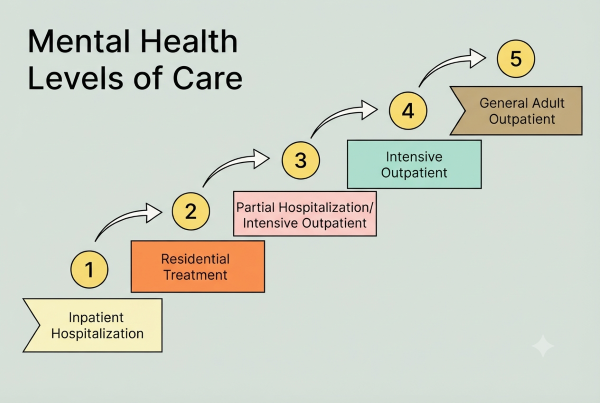
Below are important questions to consider when it comes to mental health treatment, as it’s all unique to the person. Let’s think of a ladder with various “levels of mental health care. The level of support required varies from person to person; some may require occasional support, others intensive and highly structured support 24 hours a day.
This depends on the severity of the symptoms, the need for safety, daily functioning, treatment history, medical needs, the support system and the ability to function outside of a treatment facility. The aim is usually to give sufficient support so as to meet the person’s needs, but not necessarily opt for the more restrictive setting that is available.
Comprehending these choices can make it easier for individuals and family members to make informed choices with regard to obtaining the appropriate kind of mental health services at Rise Treatment & Recovery.
Why Do Mental Health Levels of Care Matter?
Suppose that the only tools that you have are in a small toolbox and you need to repair a damaged bridge. The instruments could be helpful, but not sufficient for the task.
The process of mental health treatment is similar. For someone with mild symptoms, traditional outpatient therapy may be good. If a person has severe symptoms, great disability, or immediate risk to his or her safety, much more intensive care may be necessary.
To help, select the right level of care:
- Offer an appropriate level of clinical assistance.
- Address problem(s) before they become more serious.
- Enhance safety in times of crisis.
- Develop coping and emotional management skills.
- Where necessary, aid with medication.
- Give structure and help with accountability.
- Facilitate the transfer of persons from one treatment setting to another.
- Minimize transitions of care during the recovery process.
People may require more than one type of treatment, SAMHSA explains, and outpatient treatment can be as simple as regular appointments or as intensive as outpatient or partial hospitalization treatment.
What Are the Different Mental Health Levels of Care?
No single universal system is utilized in the same way by every supplier. Admission requirements, schedules, staffing, and services can vary from program to program and are not exactly the same as the Farmworker Unit’s.
- But there are several tiers of mental health care.
- Outpatient Care Mental Health Treatment
- Outpatient care may be the least intensive type of structured care.
- Generally remains at home, goes to appointments as scheduled, and is able to work, go to school, or perform home/family duties as appropriate.
Treatment may include:
- Individual therapy
- Group therapy
- Family therapy
- Psychiatric evaluations
- Medication management
- Behavioral health counseling
- Skills-based therapy
For outpatient care, symptoms are controlled, and the person can live reasonably safely and effectively away from treatment.
According to SAMHSA, the basic outpatient treatment involves visits during which the individual receives treatment but does not stay for the night.
Some people may find that once weekly therapy is enough. Some may have more frequent appointments.
Intensive Outpatient Program (IOP)
Intensive Outpatient Programs (IOP) offer greater structure than outpatient treatment, and the individual still lives at home.
Participants can attend numerous hours of treatment several days a week for a period of time instead of going to one appointment each week, depending on the program.
IOP may involve outpatient and
- Individual therapy
- Group counseling
- Psychiatric services
- Medication management
- Coping-skills development
- Relapse-prevention education, combined with treatment for substance use, if present.
- Family involvement
- Emotional regulation strategies
Intensive outpatient (IOP) or partial hospitalization programs are considered more intensive but are also outpatient and may involve individual sessions, groups and coping-skills education, amongst others, per SAMHSA.
24-hour treatment or residential care does not necessarily have to take place, as IOP can be very convenient when standard outpatient treatment simply isn’t enough structure.
Partially Hospitalized Program (PHP)
A Partial Hospitalization Program (PHP) offers an increased amount of structured care compared to standard outpatient treatment.
Although it does not normally require staying overnight, the word “hospitalization” is used. Most people go for treatment during the day and go home afterwards.
CMS defines psychiatric partial hospitalization as a premeditated treatment plan with a range of services that is not intended to be full-time hospitalization but is designed to provide more comprehensive care than is used in standard outpatient visits.
PHP may include:
- Intensive psychotherapy
- Group therapy
- Psychiatric evaluation
- Medication management
- Nursing support
- Behavioral health education
- Safety planning
- Family support
- Daily therapeutic activities
PHP could serve as a step between outpatient and inpatient treatment for someone who requires a high level of clinical assistance but is safe to be in an outpatient facility overnight.
Residential Mental Health Treatment
Residential treatment is still linked to behavioral health services, but it provides a structured living environment.
Rather than going to treatment for a few hours a day and following up at home, residents stay at a treatment facility and live there while going through a planned therapeutic program.
CMS considers psychiatric residential treatment settings to be settings in which 24-hour, professionally staffed, therapeutically planned care is provided.
Residential treatment might be taken into consideration when an individual requires:
- A highly structured environment
- Consistent support with therapy.
- Avoidance of a destabilizing environment
- Help establish healthy routines.
- Intensive behavioral health services
Rehabilitation for coexisting mental health issues and substance abuse problems
Residential treatment is not like someone going to the hospital for psychiatric care. Suitability of setting depends on clinical need and safety requirements as well as the individual’s functioning capacities out of the treatment setting and medical need.
Inpatient Psychiatric Treatment
Inpatient psychiatric care is one of the most comprehensive levels of psychiatric care.
It provides care in a hospital psychiatric unit that provides around-the-clock professional care, on average.
Inpatient psychiatric hospitalization, as defined by CMS, is “24-hour care in a structured facility for individuals whose needs are not appropriate for care in a less restrictive facility.”
Inpatient treatment is indicated for a significant impairment, severe psychiatric symptoms, intensive evaluation/stabilization, and a serious and immediate safety concern.
Treatment may include any of the following, depending on the circumstances:
- 24-hour nursing care
- Psychiatric evaluation
- Medication management
- Individual therapy
- Group therapy
- Safety monitoring
- Crisis stabilization
- Medical assessment
- Planning for discharge and aftercare.
The goals are to stabilize and move to a less intensive level of care as soon as it is safe and clinically appropriate.
Crisis and Emergency Mental Health Services
Addressing mental health crises calls for something different than the normal treatment of therapy.
When an individual is having an acute psychiatric crisis, he or she may require an immediate evaluation through emergency services, a crisis center, mobile crisis services or an emergency department, based upon the area and the resources available.
Some situations that need urgent action could include:
- The individual is in immediate danger of suicide or serious self-destructive acts
- Threats to kill or seriously hurt another person
- Severe psychosis
- Extreme behavioral disorganization
- Severe psychiatric symptoms that are not amenable to safe management at home.
Call 911 or immediately go to the closest emergency department if the person is in immediate danger or in danger of injuring him or herself or someone else. The Suicide and Crisis Lifeline (988) is a hotline in the United States for crises and for help and prevention.
How Is the Right Level of Mental Health Care Determined?
So, how does a treatment professional decide on a person’s place on this continuum?
It’s not as if they say, “But, how bad are your symptoms?
Some of the factors that might be included in a comprehensive assessment are
Severity of Symptoms
What severity of symptoms? What is the probability of them occurring? Are they causing them to lose sleep, to become distracted at work, school, relationships, or in basic responsibilities?
Safety
Safety is of paramount importance. If someone isn’t able to stay safe in a less structured setting, then they may require a higher level of care.
Daily Functioning
Is the person able to: Eat; Sleep; Work in the community; Attend school; Relate socially with others; Take medication, and perform daily activities?
Treatment History
Have you employed outpatient therapy, and has it been successful? Has the person been recently evaluated by a health care provider? Feel like the symptoms have returned, even with treatment?
Co-Occurring Conditions
In some cases, the mental health problem may be related to a drug abuse problem and/or to physical health problems. Such factors can modify the treatment requirements.
Home and Social Environment
Some outpatient care options may be more feasible if a supportive and stable home environment can be provided. However, if the environment is unsafe or very disruptive, it may be appropriate to consider a structured treatment environment.
Ability to Participate in Treatment
Where possible, the person is best served if he or she is able to participate meaningfully in the recommended services. Participation is thought about in the context of the ongoing environment.
When determining access to the right level of care, the American Psychiatric Association should take into account risk for harm, functioning, comorbid disorders, environmental supports, history of treatment, engagement, and social factors.
Ready to take the first step toward recovery?
Speak confidentially with our compassionate admissions team 24/7.
today.
Mental Health Levels of Care: A Simple Comparison
Level of Care | Typical Structure | Living Arrangement | General Purpose |
Outpatient | Lower intensity | Home | Ongoing therapy and psychiatric support |
IOP | Several treatment sessions per week | Home | More structure than standard outpatient care |
PHP | Intensive daytime treatment | Usually home | Intensive stabilization without overnight hospitalization |
Residential | 24-hour structured environment | Treatment facility | Intensive support and therapeutic structure |
Inpatient | 24-hour hospital-based care | Psychiatric hospital | Acute stabilization and intensive psychiatric treatment |
Crisis/Emergency | Immediate evaluation and stabilization | Emergency/crisis setting | Address urgent safety or psychiatric concerns |
These categories are general. Actual services, admission requirements, schedules, and treatment intensity vary by provider and individual circumstances.
Can Someone Move Between Different Levels of Care
Absolutely.
Treatment for mental health disorders may not be linear.
Individuals may start an inpatient treatment phase during a crisis, step down to PHP, then down to IOP and finally transition to standard outpatient treatment.
An individual can start with outpatient therapy and transition to IOP when symptoms start to get harder to handle.
This is known as the stepping up/stepping down in the care process.
The American Psychiatric Association believes in a continuum of care where individuals may receive services of varying levels, depending on the individual’s evolving needs.
Imagine it as setting the volume knob on a speaker. Sometimes it must be turned up as the message is not coming across. As it settles down, you can lower it back down.
What Happens After a Higher Level of Care?
Residential or outpatient treatment isn’t the end of treatment.
Continual care is vital in maintaining the progress in most scenarios.
Aftercare may include:
- Individual therapy
- Group therapy
- Medication management
- Family counseling
- Psychiatric follow-up
- Peer support
- Relapse-prevention planning (where applicable)
- Wellness/lifestyle strategies
- Community-based support
A person-centered discharge plan will involve a person linking up with the right services prior to exiting a more restrictive setting.

How Rise Treatment & Recovery Can Help
These are just a few of the various ways in which Rise Treatment & Recovery can assist you.
Narrowing down your choices to determine the best level of mental health care for you or your loved one can seem daunting, particularly if the signs and symptoms are impacting your whole family.
Rise Treatment & Recovery’s mission is to assist an individual in learning about the options available to them and identifying services that suit their needs and situation. Treatment may involve more individualized behavioral health supports rather than the one-size-fits-all approach.
Sometimes, it is not clear which treatment option is best: outpatient treatment, intensive outpatient care, or residential support, so it can be beneficial to consult a qualified mental health professional first.
- Not every question is “What is the most intensive level of services possible?
- A frequent question is, “Where does this level of care fit in regard to what is needed right at this moment?”
- Identifying the appropriate mental health help.
So if you are wondering if weekly therapy is enough, or if it is necessary to take things a step further, what do you do?
Finding the Right Mental Health Support
There are different levels of care for mental health issues because all of our needs are different. Outpatient treatment might offer the proper level of support to one person, but the same could not be the case for another; they might need to go for IOP, PHP, or residential treatment, or even psychiatric care, which is something that will be offered as an inpatient treatment. It can also vary over a period of time as to which one is the right one.
A higher level of care is not a failure, as long as we don’t look at it that way. With this, just as with a broken bone, sometimes more support is needed.
Through professional guidance and support, the right assessment and treatment plan, a person can progress toward increased stability and independence. At Rise Treatment & Recovery, you can discuss your treatment choices and do more to give significant mental health assistance a shot.
Healing starts with a simple conversation.
now for 24/7 confidential help and insurance verification.
Disclaimer
This blog is for educational and informational purposes only. It is not a substitute for diagnosis, treatment, or individualized medical advice from a qualified mental health professional. Mental health levels, admission criteria, and program terminology can vary by provider, state, insurer, and clinical setting.
If you are experiencing an immediate mental health emergency or believe you may harm yourself or someone else, seek emergency help or call/text 988 in the United States.
Frequently Asked Questions About Mental Health Levels of Care
What is level 4 psychiatric care?
There is no single nationwide definition of “level 4 psychiatric care.” Numbered levels can vary between healthcare systems, insurers, and clinical frameworks. In some systems, level 4 may refer to highly intensive or inpatient psychiatric services, so the specific program definition matters.
What is a level 3 mental health facility?
“Level 3” does not have one universal meaning across mental health systems. It may describe a particular intensity of residential, inpatient, or community-based care depending on the organization. Always ask the provider what services, supervision, and treatment schedule the level includes.
What is a level 5 mental health facility?
A “level 5 mental health facility” is not a standardized national designation. Different states, insurers, and organizations may use numbered systems differently. Rather than relying on the number alone, ask about supervision, staffing, treatment intensity, living arrangements, and clinical services.
What is Level 2 care in mental health?
Level 2 care can mean different things depending on the framework being used. In some systems, it may represent a more structured service than routine outpatient treatment. The exact definition should be confirmed with the provider or health plan.
What is level 1 psych ward?
“Level 1 psych ward” is not a universal clinical term. Psychiatric units are generally described by the type and intensity of care they provide, such as inpatient psychiatric hospitalization. A hospital can explain its specific classification and admission criteria.
What does tier 4 mean in mental health?
Tier 4 is not a universal mental health designation. Some organizations use tiered systems to describe increasing clinical complexity or service intensity. The meaning depends on the specific healthcare system, insurer, state, or provider using the terminology.
What are the main mental health levels of care?
Common levels include outpatient treatment, intensive outpatient programs, partial hospitalization programs, residential treatment, and inpatient psychiatric care. Crisis and emergency services may also be used when immediate psychiatric evaluation or stabilization is needed.
What is the difference between PHP and IOP?
Both provide more structure than traditional outpatient therapy. PHP is generally more intensive and may involve treatment for much of the day, while IOP typically involves fewer treatment hours. Exact schedules and eligibility requirements vary between programs.
Is residential treatment the same as inpatient psychiatric care?
No. Both can provide structured care, but inpatient psychiatric treatment is generally hospital-based and intended for acute psychiatric needs requiring 24-hour care. Residential programs provide a 24-hour therapeutic living environment but are not necessarily hospitals.
Can someone start with outpatient therapy and move to a higher level of care?
Yes. Treatment needs can change. If symptoms worsen or standard outpatient services are no longer sufficient, a clinician may recommend a more intensive level of care. Likewise, people can step down to less intensive services as their condition stabilizes.
How do I know which level of mental health care is right for me?
A qualified mental health professional can assess symptoms, safety, daily functioning, treatment history, support systems, and co-occurring conditions to determine an appropriate level of care. The safest choice depends on the individual’s current clinical needs.