
Why Understanding Your Treatment Options Matters
When it comes to treatment, one of the first questions patients and families ask is: “Is residential treatment inpatient or outpatient?” It’s an important distinction because the level of care, quality of support, and chances of long-term recovery are all directly connected to choosing the right path.
The classification of residential treatment is used as the class of inpatient treatment for residential care which entails a hospitalized/residential care facility where a person lives day to day and receives effective help, counselling and medical supervision. While there is some overlap in terminology, inpatient hospital treatment, outpatient treatment and residential treatment each serve different needs, and understanding those differences can help families make a more informed decision before entering care.
How Rise Treatment & Recovery Approaches Your Care
At Rise Treatment & Recovery, we don’t believe in a one-size-fits-all approach. We offer evidence-based treatments delivered with genuine compassion. Because addiction often comes hand in hand with co-occurring disorders and mental health disorders, knowing the difference between inpatient and outpatient treatment can ease that overwhelming sense of not knowing where to turn.
Residential treatment is, in essence, a form of inpatient rehab as the patient is always on site at the treatment facility throughout the day. These locations can also include outpatient sites, which do not have to participate in the program’s required therapy schedule in another location; however, they are patients who attend at their convenience of the program.
Key Takeaways
- Clients typically stay at a treatment facility while undergoing residential treatment, which usually results in it being considered inpatient care.
- Outpatient rehab is a treatment option that provides people the ability to attend therapy as needed without relocating to a facility.
- The key difference between residential and outpatient rehab programs is the support that is also given around the clock. Another major advantage of residential rehab programs is they offer structure, 24/7 support, and less exposure to triggers.
- The level of treatment required will depend upon the stage of addiction, the need for mental health treatment, any previous relapses, and the natural environment.
- As part of long-term recovery, many who once required residential care will recover in outpatient facilities.
Need help finding the right level of care?
Speak with our admissions team 24/7 to determine if residential treatment is right for you.
📞 Call (302) 367-5064
What is Residential Treatment?
Residential treatment is a structured recovery program in which an individual resides at a treatment facility on a full-time basis, and then receives therapy, medical care, counseling and emotional support in the facility. These are for persons who require a supervised and stable environment in the absence of day-to-day stressors and triggers.
Residential rehab programs generally involve clients in:
- Individual therapy
- Group counseling
- Family therapy
- Relapse prevention planning
- Mental health treatment
- Holistic therapies
- Life skills training
The aim is not just to prevent the use of drugs and alcohol. Good residential support enables people to regain emotional balance, develop coping resources and to establish a better basis for long term recovery.
Is Residential Treatment Inpatient Or Outpatient?
Short answer: residential treatment is usually thought of as “inpatient” treatment because the people that are treated live at the treatment facility during treatment. But, residential rehab may not seem as intense medically as an inpatient stay at a hospital.
Addiction professionals and treatment centers give regular insider tips on which focus more on medical supervision and detox support at a medical facility (inpatient work) and which put more emphasis on therapeutic recovery in a home like set up and more on long haul recovery assistance (home treatment).
Both programs have similar terms of usage, but they do have an important commonality: that patients are not discharged from the hospital each day.
This is the reason that man are confounded online about the query, “Is Residential Treatment: Inpatient or Outpatient?”This is why man confounded about the inquiry, “Is Residential Treatment: Inpatient or Outpatient?” are found searching online. The terminology used to refer to addictive treatment can be similar, but it’s the context of the treatment that will most clearly help you distinguish it between the two types.
Understanding Outpatient Treatment
Outpatient therapy and addiction treatment provide therapy and addiction treatment without removing the individual from their home.
These courses are generally recommended for those who have:
- Substance use disorders, Mild to Moderate
- Stable home environments
- Strong support systems
- Work or family commitments,
- Lower relapse risk
Treatment at an outpatient facility that may consist of:
- Weekly therapy sessions
- Intensive outpatient programs (IOP)
- Partial hospitalization programs (PHP)
- Medication-assisted treatment
- Group counseling
While outpatient treatment will certainly supply some versatility, the treatment also calls for self-responsibility. As people are being treated, they are still in contact with everyday triggers, stress, and ready to ingest substances.
Residential Treatment vs. Outpatient Rehab
The decision between inpatient vs. outpatient treatment will hinge on a number of personal and clinical factors. You are familiar with a dog, and its language is somewhat similar to yours.
Residential Treatment
- The residents are housed in the facility.
- 24/7 supervision and support
- Structured daily schedule
- Limited exposure to triggers.
- Intensive therapeutic care
- Best for acute addiction and/or relapse.
Outpatient Treatment
- Clients reside at home
- Flexible scheduling
- Lower treatment intensity
- Exposure to ongoing stressors day-to-day
Stable individuals is an appropriate group.A group appropriate to stable individuals is:
A commonly used alternative post-inpatient rehab treatment.
Recovering for many people is a gradual process. The process could start with detox and residential rehab, and may continue with outpatient rehab to receive ongoing supervision.
You don’t have to navigate recovery alone.
Get confidential, 24/7 support to explore your inpatient and outpatient care options today.
📞 Call (302) 367-5064
When is Residential Treatment Recommended?
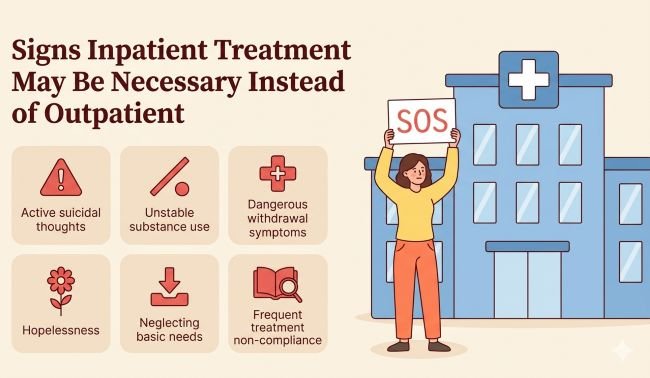
When the use of drugs or alcohol begins to seep into and impact a person’s life, residential rehab is generally recommended. These can be related to emotional health or physical health, relationships, work, emotional stability or safety.
Residential treatment may be a good option for people who:
- Had multiple relapses
- Wants help with medical detox.
- Try to give in to the strong addictions.
- Be affected by mental health issues and disorders together (comorbidity)
- Survive instable conditions
- Don’t feel able to stop on their own
Emotional distance is another benefit of residential treatment; it serves to give you some space to get away from negative surroundings or bad habits that lead to addiction.
Treatment plans are tailored to each patient at Rise Treatment & Recovery due to no two paths to recovery being the same.
What Happens During Residential Rehab?
A common nightmare is not knowing what to expect. Residential rehab is organized, however, also supportive. Most programs have a set routine for their daily activities that are based on healing and stability.
Some of the things a normal day might consist of:
- Morning wellness activities
- Individual counseling sessions
- Group therapy
- Educational workshops
- Mental health treatment
- Healthy meals
- Hobbies or relaxation exercises
- Evening recovery meetings
The surroundings are structured to enable clients to concentrate totally on healing from their addiction without outside interference.
Mental Health and Residential Care
Addiction is intimately tied with mental health. Other common conditions that are seen when someone decides to attend treatment is anxiety, depression, trauma, PTSD, and/or mood disorder.
Individuals affected by co-occurring disorders may benefit from residential treatment facilities, as they offer around-the-clock emotional support and an integrated treatment, which is more beneficial than that offered through outpatient facilities. If a mental health issue is not addressed, addiction is more likely to be a recurring problem.
Residential rehab programs are generally more effective for those who have complicated emotional or mental issues as one reason.
How Long Does Residential Treatment Last?
The length of the treatment is based on the individual’s needs, recovery and treatment goal.
Typical length of treatment for residential care is:
- 30 days
- 60 days
- 90 days
- Extended care programs
Each of the available research findings demonstrates that greater duration of treatment engagement is related to improved treatment outcomes at follow-up. For some, it’s possible to continue to be treated as an outpatient after residential treatment ends.

Does Insurance or Medicare Cover Residential Treatment?
The coverage available under an insurance policy will depend upon the provider and the specific policy. Medicare may have coverage for some medically necessary rehabilitation care, but it will depend on the type of care and the length approved.
Families should also always check with both treatment centers and insurance companies to fully understand eligibility requirements, coverage limits and amounts of costs they will have to pay themselves. You can verify coverage through our insurance verification page.
Why Choosing the Right Treatment Matters
The first problem is one of convenience or the selection of a program. Recovery is individual.
For people who have been addicted for longer periods of time, outpatient treatment is still an easier option, but it may be advisable to seek residential treatment. Outpatient care may be a choice, however, for those with mild symptoms who are able to find the necessary resources.
The best course of treatment is treatment of person’s needs – emotional, physical and psychological.
Start Healing With Rise Treatment & Recovery
Addiction isn’t something to be treated by someone who has no knowledge, skill, or addiction treatment background on the subject, and addiction treatment and other mental health care service providers can make it easier and more effective. Compassionate treatment procedures for each client, tailored to meet their specific needs; evidence-based treatments using the best practices; and supportive staff.
We know that this can be a painful first step. Your call can be a call for help, and we’re here in dignity and respect to help you get your life back in order: residential rehab, outpatient treatment or dual diagnosis assistance. For those seeking a faith-centered approach, we also offer faith-based recovery.
Call Rise Treatment & Recovery today to discuss a tailored program and begin your journey to recovery.
Take the first step toward recovery today.
Call our helpline 24/7 for a confidential assessment and insurance verification.
📞 Call (302) 367-5064