
Quick Answer: Levels of care are related to the type of care setting in which these addiction and/or mental health issues are treated and the severity of the problem. Depending on the clinical needs of the patient, a variety of care settings might exist, ranging from outpatient therapy to intensive outpatient (IOP), partial hospitalization, or residential/inpatient care.
Doctors might find it easier to decide on care when they understand the levels of care. Treatment doesn’t usually look the same for one person versus another, especially when it is for drug and alcohol addiction versus co-occurring mental health issues. This depends on the person’s symptoms and medical condition, the type of substance that was ingested, how often the substance is abused, the surrounding environment for the recovery process, and the level of structure and support needed. ASAM criteria can be applied to inform the decision for level of care in addiction treatment.
Key Takeaways
Levels of care can be a way of linking the level of care to the person’s needs. These may include outpatient services, intensive outpatient services (IOP), outpatient hospital services (PHP), residential treatment, and inpatient care. There are also withdrawal management services and recovery support services that can be applied for addiction treatment.
Treatment should not be seen as a ladder to climb from the bottom to the top. An individual might require entry at a higher level of services if they have needs that require it and then move into lower-level services. In fact, it is important to continue to reassess, as clinical needs might evolve over the course of a recovery process.
Understanding Mental Health Treatment Levels of Care
Treatment levels of care for mental health are the same: that the level of treatment should correspond to the person’s needs. They’re typically set in outpatient therapy, IOP, PHP, residential treatment, and inpatient psychiatric hospitalization. They vary in factors like supervision and frequency of treatment, level of safety monitoring, environment, and time.
Inpatient psychiatric treatment, for instance, is indicated if a patient presents with an acute safety problem that requires constant watch. Residential treatment is a type of structured therapy that is offered in a treatment setting but is not as hospital-driven as the treatment at hospitals. PHP and IOP are structured treatments but give the person the option to live outside the treatment setting. With experience, however, it isn’t uncommon for people to get started with outpatient therapy, which is typically the least intensive option.
What Are the ASAM Criteria?
The ASAM Criteria are guidelines that provide a framework for professionals to evaluate a person’s needs that relate to addiction and what level of care is required. The fourth edition that is currently available employs a multidimensional, person-centered approach that incorporates medical and psychiatric symptoms, substance use, recovery environment, and personal factors.
The ASAM Criteria, in essence, is used to answer the question, “What kind and how much treatment is safe and effective for this individual’s current needs? The criteria detail the treatment levels and quality of services, staffing, setting, and intensity. Patients are also reviewed and continue to be assessed throughout the course of therapy to facilitate a transition to a more or less intense setting.
What Are the ASAM Dimensional Admission Criteria?
The ASAM dimensional admission criteria assist clinicians’ linkage of assessment findings with a recommended level of care. The assessment focuses not only on the severity of the substance use but also on a variety of other domains that may have an impact on issues such as safety, need for service, and recovery. This 4th edition incorporates the 6 dimensions and additional subdimensions.
This is significant since individuals with the same substance use diagnosis may require vastly different services. Some people may need medical assistance; others could need therapy, structured therapy, and recovery support. Challenges and strengths are taken into account in the assessment, including with regard to resources, support systems, their treatment preferences, barriers to treatment, etc.
How the Process Works
Generally, the treatment starts with a thorough examination. A qualified professional assesses the individual’s substance use, physical health, mental health, situation, risks, supports for recovery, and so forth. The findings are then reviewed in light of the ASAM guidelines to determine the level of intensity and treatment received, which might be warranted.
The admission process is not the only thing that stops after admission. Treatment teams should continually assess progress and changing needs. When stability improves, a person might transition from residential treatment to PHP or IOP and ultimately, outpatient treatment. A higher level may be appropriate if there is a greater amount of symptoms or risks. This allows treatment to be responsive and not one-size-fits-all.
Wanting to know about options for you or a loved one? Rise Treatment & Recovery can answer any questions you may have about treatment and what kind of treatment might be right for you. Please get in touch with (302) 367-5064 and speak to the staff to take the next step towards recovery.
Take the First Step Toward Recovery Today
Speak confidentially with our compassionate admissions team, available 24/7 to guide you through detox and residential treatment options.
Why the ASAM Criteria Matter
Substance use isn’t the only thing that is affected by addiction, and that’s why the ASAM Criteria are important. Physical condition and psychiatric symptoms, risk of relapse, social factors, and resources can affect the need for treatment. Multidimensional assessment allows a ‘big picture’ look at the patient instead of one symptom or diagnosis.
They help to establish a common ground for treatment intensity conversation as well. This can lead to improved communication between treatment professionals, patients, families, and payers. Importantly, the criteria are not intended to supplant professional judgment. They offer a convenient framework for use by clinicians in conjunction with individual assessment and clinical decision-making.
What are the ASAM Criteria Used For?
The ASAM Criteria support the process of assessment, treatment planning, level-of-care recommendations, and treatment continuation or change decisions. They’re especially relevant to the level of care when it comes to specialty addiction treatment, where patients may suffer from a mix of medical, psychiatric, addiction, and environmental conditions.
They can also be used to guide the treatment provider to decide if the person would benefit from a more intensive service or may need a more structured service. It is not the objective merely to make a diagnosis. To understand the level of structure and services that are suitable for the person in their present context.
What Are the Different Levels of Care in Rehab?
There are varying degrees of care offered at rehab, from less intensive outpatient options to highly structured residential and inpatient care. Among people undergoing rehab, there are different levels of care ranging from less intensive outpatient care to very structured residential and inpatient care. Common services include outpatient care, which is either an intensive outpatient program or a partial hospitalization program near Golden, CO, and residential or inpatient treatment. Depending on individual medical risk, withdrawal management might be required before or in conjunction with continued addiction treatment.
One example is outpatient treatment, which gives the option of staying home while getting to appointments for treatment. IOP provides more structure and frequent therapy. Most of the time, PHP requires treatment during the day, but not at night. Residential care is an environment that suits structured living, and inpatient hospital treatment is for situations where it is necessary to monitor someone’s medical or psychiatric care intensively.
ASAM Dimensions
Six dimensions are utilized in the current ASAM Fourth Edition:
- Medications for intoxication, withdrawal, and addiction
- Biomedical Conditions
- Psychiatric and cognitive problems
- Substance Use-Related Risks
- Recovery Environment Interactions
- Person-Centered Considerations
Note that six dimensions may be defined differently in older online resources. For the third edition, it was Readiness to Change. The Fourth Edition acknowledges readiness throughout the assessment, instead of as a separate dimension, and a new person-centered Dimension 6 is included to capture factors that may affect readiness (such as barriers to care, preferences, and motivational needs).
What are the Five Levels of Care?
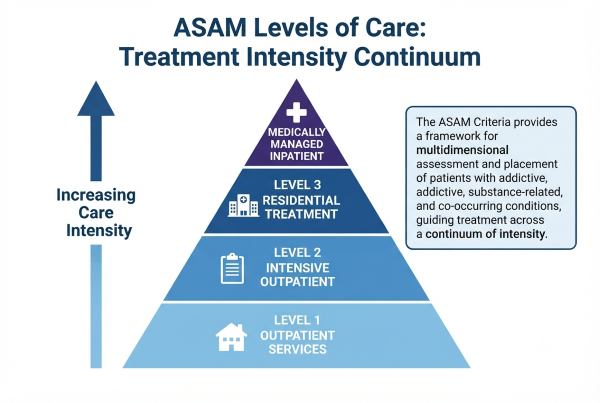
There are five broad, general stages of addiction treatment in the current ASAM, but people are more commonly focusing on the five stages of care. The continuum falls into the range of 1–4, with some variations between the levels being indicated by a decimal number, which represents the type and quantity of services.
In their practical experience, people could come into contact with Level 1 outpatient, Level 2 intensive outpatient/partial hospitalization, Level 3 residential, or Level 4 inpatient services. Details are represented at decimal levels. For instance, there are ASAM materials for Levels 2.1, 2.5, 3.1, 3.5, and 3.7 and special variants as well as Level 4.
A Simple View of Treatment Intensity
Level | General description |
Level 1 | Outpatient services |
Level 2 | Intensive outpatient and partial hospitalization/day treatment |
Level 3 | Residential treatment |
Level 4 | Inpatient treatment |
The exact services within each level can vary, and an individual’s needs determine the appropriate placement.
How Do Rehab Centers Qualify for ASAM Certification?
ASAM Level of Care Certification is a program for determining independently whether or not a treatment program has the capacity to provide services in accordance with identified ASAM level-of-care standards. The certification program is provided in collaboration with CARF International and includes adult residential Levels 3.1, 3.5, and 3.7, according to ASAM.
To become a certified provider, one must go through CARF’s application procedure that includes an on-site survey and analysis of the program’s compliance with the appropriate rating elements. Programs that are certified have proven their ability to deliver the level of care provided. It does not refer to a general accreditation, or a view on the quality of all the services a facility offers, or a license.

Take the Next Step Toward the Right Level of Care
Treatment choices can be confusing, and it can appear that phrases such as “PHP,” “IOP,” “residential treatment,” and “ASAM levels” are all thrown around. Do not have to figure it out and do it alone. The professional assessment helps the person seeking drug and alcohol treatment to determine the level of care that is needed at this time, what they are used to, what they can handle, and what they require.
Rise Treatment & Recovery can assist you in figuring out your alternatives and what help may be proper. To talk with the staff about treatment and recovery services, call (302) 367-5064.
The purpose isn’t just to go in for treatment. It’s about getting care that reflects your current state and supports and empowers your journey. Making it easier and more informed is understanding levels of care for mental health and addiction treatment options, as well as the ASAM criteria and levels of care in addiction treatment.
Help and Healing Begin with a Single Call
Whether you’re reaching out for yourself or a loved one, we are here to listen with clarity and care. Get free, 24/7 guidance with zero obligation.
Speak with Admissions Now:
Frequently Asked Questions About Levels of Care
What are the ASAM dimensions and levels of care in addiction treatment?
The ASAM Fourth Edition uses six dimensions to assess individual needs and four broad treatment levels, numbered 1 through 4. Decimal levels provide additional detail about treatment intensity, setting, and specialized services.
What are the different levels of care for addiction treatment?
Addiction treatment may include outpatient care, intensive outpatient services, partial hospitalization, residential treatment, and inpatient care. Withdrawal management and recovery support may also be incorporated depending on a person’s medical, psychiatric, substance-use, and recovery needs.
What does ASAM level of care 3.7 represent in addiction treatment?
ASAM Level 3.7 is a high-intensity residential level within the ASAM continuum. The Fourth Edition also identifies medically managed and specialized variations associated with Level 3.7, depending on the individual’s assessed clinical needs.
What is level 2.5 of care in the ASAM criteria?
Level 2.5 is a high-intensity outpatient level within the ASAM continuum. It provides structured treatment without requiring a person to live in a residential facility. Exact services and placement depend on the individual’s multidimensional assessment and treatment needs.
What are the different levels of care in rehab?
Rehab may offer outpatient, IOP, PHP, residential, or inpatient services. Some treatment systems also provide withdrawal management, transitional living, sober living, and aftercare. The appropriate service depends on clinical needs rather than simply how severe an addiction appears.
What is ASAM level 1 treatment?
ASAM Level 1 generally refers to outpatient treatment within the addiction treatment continuum. The current Fourth Edition also includes Level 1.5 and 1.7 variations, reflecting different intensities and capabilities within the broader Level 1 category.
What are the five levels of care?
The current ASAM Fourth Edition describes four broad treatment levels, not five: Levels 1 through 4. Decimal designations create additional treatment categories within those broad levels, which is why online descriptions can sometimes appear to show more than four.
What does ASAM level 3.3 mean?
ASAM Level 3.3 is a residential level associated with clinically managed population-specific high-intensity residential services in the ASAM framework. Because terminology and standards can change between editions, placement should be based on the edition and criteria being used by the treatment provider.
What does Dimension 4 of the ASAM Criteria assess?
In the Fourth Edition, Dimension 4 is Substance Use-Related Risks, including risks related to substance use and substance-use-related behaviors. In the older third edition, Dimension 4 was Readiness to Change, so older resources may use different terminology.
Disclaimer
This blog is intended for general educational and informational purposes only. It does not provide medical, psychiatric, psychological, or addiction-treatment advice and should not replace an evaluation by a qualified healthcare professional. ASAM terminology and treatment standards may change between editions, and individual placement decisions should be made by appropriately qualified professionals based on the person’s current needs. If there is an immediate risk of overdose, serious withdrawal, self-harm, suicide, or harm to another person, seek emergency medical assistance immediately.
References and Authoritative Sources
- American Society of Addiction Medicine (ASAM) Criteria for current information about assessment, dimensions, and levels of care.
- ASAM Criteria, Fourth Edition for current Fourth Edition information and updates.
- National Association of Addiction Treatment Providers (NAATP) for an overview of the addiction treatment continuum.
- Anxiety & Depression Association of America (ADAA) for information about mental health treatment levels.